(Updated October, 2026)
Writing historical fiction can be both an educational and challenging endeavor—and an excellent way to spark your creativity.
Even if you don't write historical fiction, history can provide inspiration for stories in almost any genre. A real event, person, letter, or place can become the starting point for an entirely new story. You can take what you learn, embellish it, change the circumstances, and let history inspire your imagination.
For today's writing prompt, we're stepping into the Civil War era.
But we're not going onto the battlefield. Instead, this prompt asks you to look at war through the eyes of a civilian.
The soldiers aren't the only people affected by war.
- Families are separated
- Homes are occupied
- Possessions are lost
- Communities are disrupted
- Ordinary people are forced to make difficult choices
Your challenge is to write from the point of view of a civilian caught in the middle of the conflict.
You can use the historical situation below as your starting point, write from the perspective of the person who actually experienced it, or create an entirely fictional character, in a fictional world, living through similar circumstances.
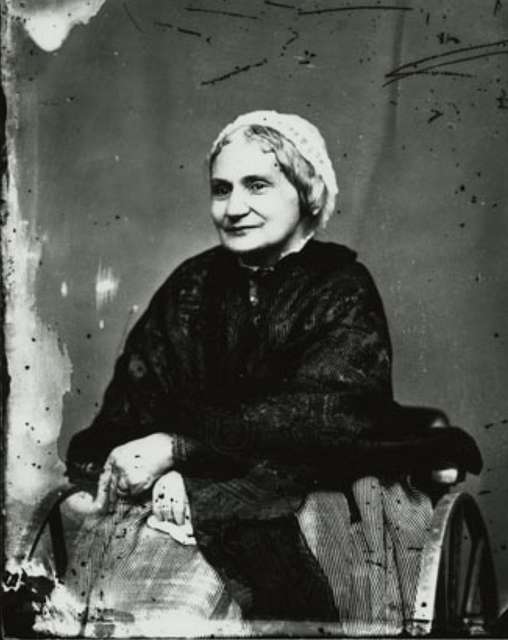 |
| Mary Custis Lee in Old Age. Wearing a night cap and shawl, Mary Anna
Randolph Custis Lee, the wife of Robert E. Lee, sits in a wheelchair in
Lexington, Virginia, around 1868. This glass-plate image was made by
local photographer Michael Miley. |
Who, What, When, Where, and Why?
Who is writing the letter?
Mary Custis Lee, wife of Confederate General Robert E. Lee.
Mary Anna Randolph Custis Lee was born in 1806 and died in 1873. She and Robert E. Lee were married in 1831 and made their home at Arlington House in Virginia.
Who is the letter written to?
Union General Sanford.
When was it written?
May 30, 1861.
Why was it written?
Mary Custis Lee was writing to express her distress over the military occupation of her home, Arlington House, by Union troops.
Where does the story take place?
Arlington House in Virginia, the home of the Lee family.
The Historical Letter
Here is part of the surviving letter that inspired today's prompt:
30th May 1861
It never occurred to me Gen'l Sanford that I could be forced to sue for permission to enter my own house and that such an outrage as its military occupation to the exclusion of me and my children could ever have been perpetrated by anyone in the whole extent of this country.
I had been warned by an anxious friend that such a design was in contemplation nearly a month ago & advised to remove to a place of safety all my property that was of any value. Still incredulous I complied with his earnest entreaties in regard to the Mt. Vernon relics, plate, & pictures that we could never replace and after a visit of about 10 days to a friend in Fairfax was preparing…
The surviving words give us only part of the story. That's where your writer's imagination comes in.
- What happened before this letter was written?
- What was Mary thinking when she learned that soldiers were occupying her home?
- What did she fear losing?
- What would it feel like to know that you could no longer simply walk through the door of your own house?
- And what might happen next?
Pumping Your Muse Writing Prompt
Imagine you are a civilian living during the (or a different) Civil War. Your home, or the home of someone you love, has been occupied by military forces. You cannot simply walk in and reclaim it.
Write the scene from the civilian's point of view.
You might write:
- a letter to a military officer
- a private letter to a family member
- a diary entry
- a conversation between family members
- a scene in which the character approaches the occupied home
- a fictional account of what happened immediately before or after the letter
- or an entirely different story inspired by the historical circumstances
You don't have to write about Mary Custis Lee.
In fact, I challenge you to try creating your own character.
Perhaps she's a farmer's wife whose home has become a military post. Maybe she's a shopkeeper trying to keep her business open. Perhaps she's a child who doesn't understand why soldiers are sleeping in the house. Or maybe she's an older woman determined to protect a family heirloom.
The possibilities are as varied as the people who lived through the war.
Three Types of Conflict
Whatever story you choose to write, consider incorporating three levels of conflict.
1. External Conflict
What is happening outside your character?
Perhaps soldiers have arrived. The character has been displaced from her home. Food is becoming scarce. Travel is dangerous. Property is being confiscated. The character may have to navigate military orders or changing loyalties.
2. Interpersonal Conflict
How does the situation affect your character's relationships?
Conflict might arise between a husband and wife, parents and children, neighbors, friends, or even the protagonist and the military officer controlling the situation.
Perhaps the protagonist wants to leave while someone she loves refuses.
Perhaps two people disagree about whether to cooperate or resist.
Or perhaps someone the protagonist trusted has made a choice she cannot forgive.
3. Internal Conflict
What battle is taking place inside your protagonist?
This may be the most important conflict of all.
Your character may be frightened but determined not to show it. She may be angry but know that acting on that anger could endanger her family. She may feel helpless, guilty, betrayed, or torn between protecting herself and protecting someone else.
War doesn't only threaten a person's physical safety.
It can threaten their sense of home, identity, security, and control.
That's where internal conflict becomes especially powerful.
Think Beyond the Battlefield
When we think about Civil War stories, it's easy to picture soldiers, battles, uniforms, and weapons.
But war reaches far beyond the battlefield.
- It enters kitchens and bedrooms.
- It changes family relationships.
- It empties farms.
- It separates husbands from wives and parents from children.
- It turns familiar roads into dangerous ones.
- And sometimes it means that a person can no longer enter her own home.
Those quieter consequences of war can create some of the most compelling historical fiction.
So as you write, ask yourself:
What does war look like to someone who isn't carrying a weapon?
If you want to turn this prompt into a historical fiction scene, research can help bring it to life.
Look into:
- Arlington House and its history during the Civil War
- Civil War-era clothing
- Women's daily lives during the 1860s
- Civilian life in Virginia during the war
- Military occupation of civilian homes
- Transportation and communication during the period
- Household furnishings and possessions
- The treatment and preservation of family heirlooms
Historical details don't have to overwhelm your story. A few carefully chosen details can make a scene feel much more authentic. Start with what would your character sees when he/she opens a door?
And one more thing to note: The US
Constitution, Third Amendment: “No Soldier shall, in time of peace be quartered
in any house, without the consent of the Owner, nor in time of war, but in a
manner to be prescribed by law.”
Sources: (Mary
Custis Lee papers. Accession No. 0080-001)


