Monday, September 16, 2024

Monday Morning Muse: Recycling writing

 "Good morning and happy Monday! 🌟 

Monday Morning Muse

As we step into the new week, may your day be filled with inspiration and creativity. Remember, every challenge is a chance to grow and every moment is an opportunity to shine. Let the possibilities of this week unfold like a fresh canvas, and may you find joy in every little discovery along the way. Here’s to a Monday that sets the tone for a fantastic week ahead!

Today's Pumping Your Muse Writing Prompt

Recycling writing 

For today's creative challenge, dig out one of your unfinished fiction projects and take a look at it. If it's an older piece, and you've written for years, it can be an eye-opener to see how much you've grown as a writer. And you may also see the merit in your original idea. The question is, why is it unfinished. Did you get stuck? Lose interest? Did it grow cumbersome and too complicated?

Refresh your memory and re-immerse yourself in the story. 

  • If the story starts to wander or lose focus stop reading. That's your starting point. 
  • If you couldn't figure out how to end it. When you reach that point in your reading. Stop. That is your starting point.
  • If you recognize it is too cumbersome stop when you recognize it. That is your starting point. 

Based on your starting point write a short story related to your narrative, but write it from a secondary character's POV in the first person. Let them talk. If you're lucky, they'll tell you something you didn't know, and it might just be what you need to finish the story.


Sunday, June 16, 2024

Lost Baseball Writing Prompt

On my morning walk, I spotted a baseball sitting precariously in the brush over drainage water from a culvert that ran beneath the street. I wondered who owned the ball and how it got there. I walked by in the afternoon and it was still there. Would it be retrieved by the owner or found by another child. All kinds of possible storylines ran through my mind and I wondered if the story of the 1993 Sandlot film came about with such a simple find.

I decided to take a picture and make this a writer's prompt for all of you. If you'd like, take a look at the picture at let your imagination take on the journey of discovery of the story within. If you need a little prompting, here is today's writing prompt.

Baseball writing prompt


Today's writing prompt

Write a story about a weathered baseball wedged in the thin branches overhanging over water. The ball, seemingly abandoned and forgotten, becomes a symbol of hope and connection for two children from different backgrounds who stumble upon it. As they collaborate to retrieve the ball, they embark on a journey that transcends their differences, teaching them about teamwork, empathy, and the unexpected bonds that form in unlikely places.

* * *

Some links in this post are affiliate links. We are a participant in the Amazon Services LLC Associates Program, an affiliate advertising program designed to provide a means for us to earn fees by linking to amazon.com and affiliate sites.


Tuesday, April 30, 2024

The Timekeeper's Enigma writing prompt

(Updated October, 2026) 

Time travel fiction is a rich genre filled with various elements that captivate readers and viewers alike. Here are some key elements commonly found in time travel fiction.


Timekeeper artifact

Time Machine/Device: The means by which characters travel through time is often central to the story. This could be a physical machine like H.G. Wells' iconic Time Machine, a device created by advanced technology, or even a mystical artifact.

 
Temporal Paradoxes: Time travel often introduces paradoxes, such as the grandfather paradox (where one's actions in the past could alter their own future existence) or the bootstrap paradox (where an object or information is brought from the future into the past, creating a loop with no discernible origin).

 
Altering History: Characters may grapple with the consequences of changing historical events. This can lead to moral dilemmas and ethical questions about the nature of free will and the responsibility of time travelers.

 
Alternate Timelines/Realities: Time travel can create branching timelines or alternate realities, where different outcomes result from altered events in the past. Exploring these alternate worlds can add depth to the narrative and offer insights into characters' choices.

Butterfly Effect


Butterfly Effect: Small changes in the past can have significant ripple effects on the future, known as the butterfly effect. This concept is often explored in time travel fiction, highlighting the interconnectedness of events and the unpredictability of causality.


Fixed Points in Time: Some stories feature fixed points in time that cannot be altered without dire consequences. Characters may struggle to navigate these fixed points while attempting to achieve their goals.


Time Loops: Characters may find themselves trapped in repeating cycles of time, reliving the same events over and over again. Breaking free from these loops often requires a deeper understanding of their circumstances and personal growth. Ground Hog Day is a good example.

Multiverse


Multiverse Theory: Time travel fiction sometimes incorporates the idea of parallel universes or multiverses, where every possible outcome exists simultaneously. Traveling between these parallel worlds can open up new narrative possibilities and philosophical explorations.


Temporal Guardians/Authorities: In some stories, there are organizations or individuals tasked with regulating time travel and preventing its misuse. These temporal guardians may act as mentors, guides, or adversaries to the main characters.


Personal Consequences: Time travel can take a toll on the mental and emotional well-being of characters, as they grapple with the weight of their experiences and the knowledge of what could have been. Themes of loss, regret, and redemption often play a significant role in these stories.

By weaving together these elements, time travel fiction offers a captivating exploration of human nature, destiny, and the nature of time itself.

Backstory for Timekeeper's Enigma  

In the quiet town of Everbrook, nestled between ancient forests and rolling hills, time had always been a reliable companion. That is until the day it disappeared.

It started subtly, with clocks ticking slightly faster or slower than usual. Residents shrugged it off, blaming it on old mechanisms or changing weather patterns. But soon, watches stopped altogether, and digital displays froze mid-second. Panic spread like wildfire through the town as people realized they were trapped in a timeless limbo.

The town's only hope lay in the enigmatic figure known as the Timekeeper, rumored to be an ageless guardian with the ability to control time itself. Whispers of their existence had always circulated in Everbrook, but few had ever seen them.

As the town plunged into chaos, a young journalist named Eliza vowed to uncover the truth behind the Timekeeper's legend. Armed with her notepad and determination, she delved into Everbrook's history, uncovering forgotten tales of time manipulation and ancient prophecies.

Her investigation led her deep into the heart of the forest, where whispers spoke of a hidden grove guarded by time's magic. There, amidst the gnarled trees and shimmering light, she encountered the Timekeeper.

Travel through time

 Today's Writing prompt: The Timekeeper's Enigma 

1. Choose the time travel element you want to base your story on

2. Write a scene based on the above prompt and incorporating the element of your choice. 

3. The goal of this prompt: Reveal the truth about the Timekeeper. 

Additional prods for poking your muse if you are stuck: 

Time is not a force to be controlled but a balance to be maintained and something has disturbed the balance. If the balance is not restored, what happens to Everbrook?

  • Does Eliza join forces with the Timekeeper or does she have to work solo?
  • Provide at least two clues to unravel
  • Ability to travel through frozen moments in time
  • Battle against unseen/visible forces 
  • Discovery of a hidden ritual in the past to restore time's flow 


Tuesday, April 16, 2024

Civil War Writing Prompt: A Civilian's Perspective

(Updated October, 2026) 

Writing historical fiction can be both an educational and challenging endeavor—and an excellent way to spark your creativity.

Even if you don't write historical fiction, history can provide inspiration for stories in almost any genre. A real event, person, letter, or place can become the starting point for an entirely new story. You can take what you learn, embellish it, change the circumstances, and let history inspire your imagination.

For today's writing prompt, we're stepping into the Civil War era.

But we're not going onto the battlefield. Instead, this prompt asks you to look at war through the eyes of a civilian.

The soldiers aren't the only people affected by war. 

  • Families are separated
  • Homes are occupied
  • Possessions are lost
  • Communities are disrupted
  • Ordinary people are forced to make difficult choices

Your challenge is to write from the point of view of a civilian caught in the middle of the conflict.

You can use the historical situation below as your starting point, write from the perspective of the person who actually experienced it, or create an entirely fictional character, in a fictional world, living through similar circumstances.
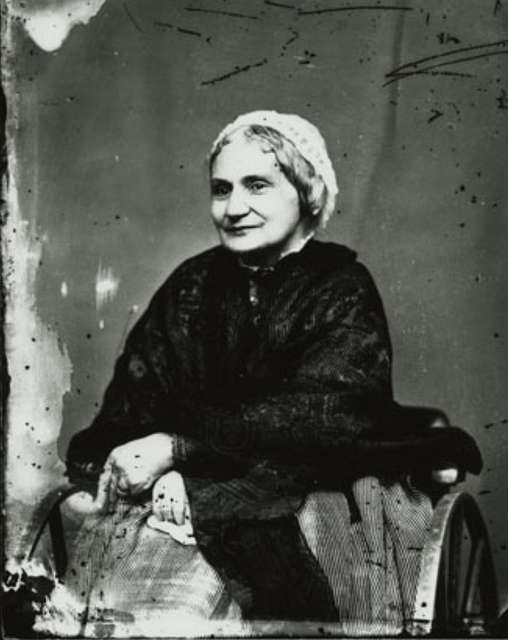
Mary Custis Lee in Old Age. Wearing a night cap and shawl, Mary Anna Randolph Custis Lee, the wife of Robert E. Lee, sits in a wheelchair in Lexington, Virginia, around 1868. This glass-plate image was made by local photographer Michael Miley.

Who, What, When, Where, and Why?

Who is writing the letter?

Mary Custis Lee, wife of Confederate General Robert E. Lee.

Mary Anna Randolph Custis Lee was born in 1806 and died in 1873. She and Robert E. Lee were married in 1831 and made their home at Arlington House in Virginia.

Who is the letter written to?

Union General Sanford.

When was it written?

May 30, 1861.

Why was it written?

Mary Custis Lee was writing to express her distress over the military occupation of her home, Arlington House, by Union troops.

Where does the story take place?

Arlington House in Virginia, the home of the Lee family.

Arlington House

The Historical Letter

Here is part of the surviving letter that inspired today's prompt:

30th May 1861

It never occurred to me Gen'l Sanford that I could be forced to sue for permission to enter my own house and that such an outrage as its military occupation to the exclusion of me and my children could ever have been perpetrated by anyone in the whole extent of this country.

I had been warned by an anxious friend that such a design was in contemplation nearly a month ago & advised to remove to a place of safety all my property that was of any value. Still incredulous I complied with his earnest entreaties in regard to the Mt. Vernon relics, plate, & pictures that we could never replace and after a visit of about 10 days to a friend in Fairfax was preparing…

The surviving words give us only part of the story. That's where your writer's imagination comes in. 

  • What happened before this letter was written?
  • What was Mary thinking when she learned that soldiers were occupying her home?
  • What did she fear losing?
  • What would it feel like to know that you could no longer simply walk through the door of your own house?
  • And what might happen next?  

 
Civil War Era Characters

Pumping Your Muse Writing Prompt

Imagine you are a civilian living during the (or a different) Civil War. Your home, or the home of someone you love, has been occupied by military forces. You cannot simply walk in and reclaim it.

Write the scene from the civilian's point of view.

You might write:

  • a letter to a military officer
  • a private letter to a family member
  • a diary entry
  • a conversation between family members
  • a scene in which the character approaches the occupied home
  • a fictional account of what happened immediately before or after the letter
  • or an entirely different story inspired by the historical circumstances

You don't have to write about Mary Custis Lee.

In fact, I challenge you to try creating your own character.

Perhaps she's a farmer's wife whose home has become a military post. Maybe she's a shopkeeper trying to keep her business open. Perhaps she's a child who doesn't understand why soldiers are sleeping in the house. Or maybe she's an older woman determined to protect a family heirloom.

The possibilities are as varied as the people who lived through the war.

Three Types of Conflict

Whatever story you choose to write, consider incorporating three levels of conflict.

1. External Conflict

What is happening outside your character?

Perhaps soldiers have arrived. The character has been displaced from her home. Food is becoming scarce. Travel is dangerous. Property is being confiscated. The character may have to navigate military orders or changing loyalties.

2. Interpersonal Conflict

How does the situation affect your character's relationships?

Conflict might arise between a husband and wife, parents and children, neighbors, friends, or even the protagonist and the military officer controlling the situation.

Perhaps the protagonist wants to leave while someone she loves refuses.

Perhaps two people disagree about whether to cooperate or resist.

Or perhaps someone the protagonist trusted has made a choice she cannot forgive.

3. Internal Conflict

What battle is taking place inside your protagonist?

This may be the most important conflict of all.

Your character may be frightened but determined not to show it. She may be angry but know that acting on that anger could endanger her family. She may feel helpless, guilty, betrayed, or torn between protecting herself and protecting someone else.

War doesn't only threaten a person's physical safety.

It can threaten their sense of home, identity, security, and control.

That's where internal conflict becomes especially powerful.

Think Beyond the Battlefield

When we think about Civil War stories, it's easy to picture soldiers, battles, uniforms, and weapons.

But war reaches far beyond the battlefield.

  • It enters kitchens and bedrooms.
  • It changes family relationships.
  • It empties farms.
  • It separates husbands from wives and parents from children.
  • It turns familiar roads into dangerous ones.
  • And sometimes it means that a person can no longer enter her own home.

Those quieter consequences of war can create some of the most compelling historical fiction.

So as you write, ask yourself:

What does war look like to someone who isn't carrying a weapon?

Research Your Setting

If you want to turn this prompt into a historical fiction scene, research can help bring it to life.

Look into:

  • Arlington House and its history during the Civil War
  • Civil War-era clothing
  • Women's daily lives during the 1860s
  • Civilian life in Virginia during the war
  • Military occupation of civilian homes
  • Transportation and communication during the period
  • Household furnishings and possessions
  • The treatment and preservation of family heirlooms

Historical details don't have to overwhelm your story. A few carefully chosen details can make a scene feel much more authentic. Start with what would your character sees when he/she opens a door?

And one more thing to note: The US Constitution, Third Amendment: “No Soldier shall, in time of peace be quartered in any house, without the consent of the Owner, nor in time of war, but in a manner to be prescribed by law.”

Sources: (Mary Custis Lee papers. Accession No. 0080-001)